
About > Public Safety


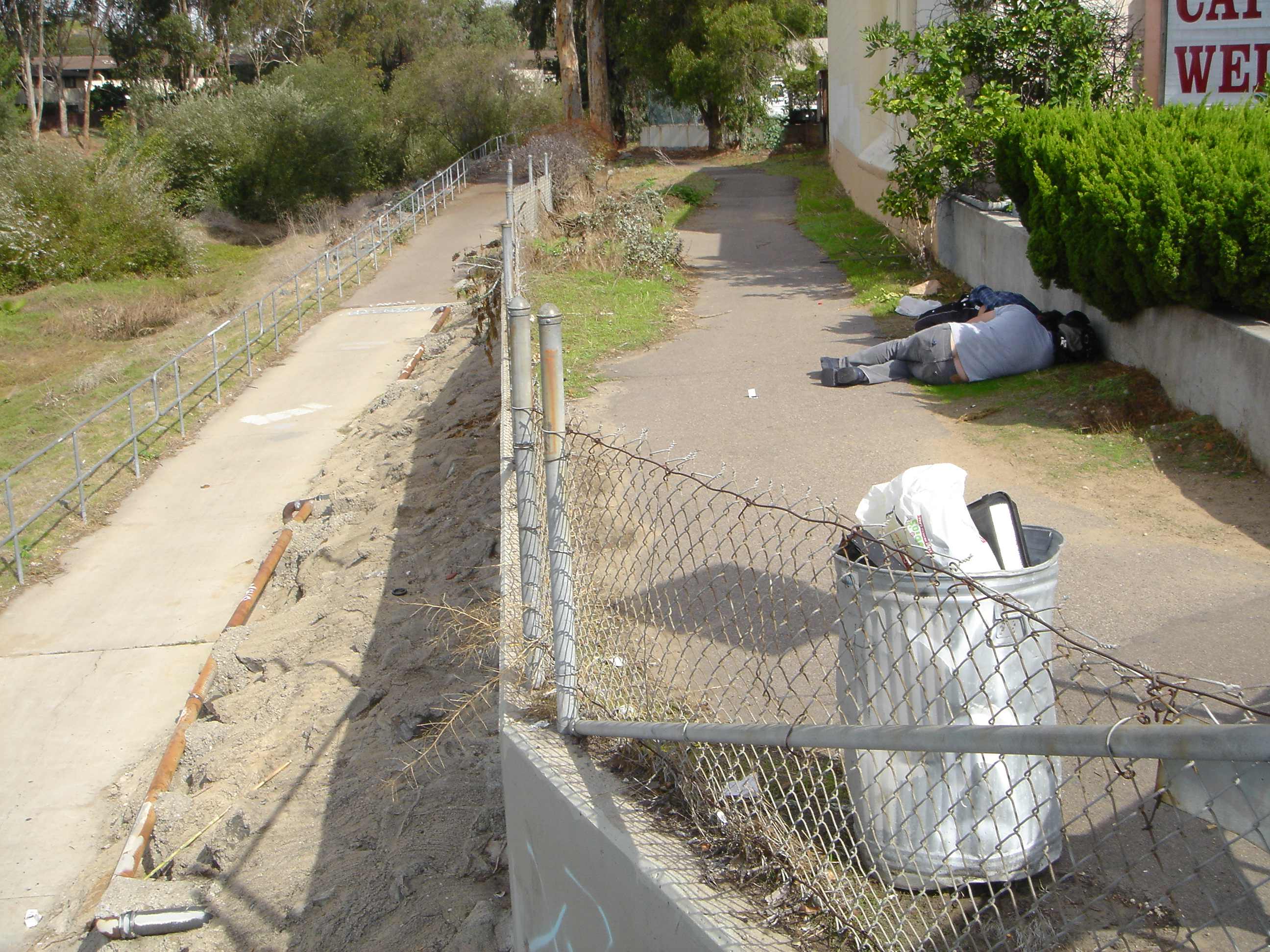
Bike path in Lower Rose Creek.
Photo: San Diego Earthworks

The City of San Diego is blessed with a unique topography of canyons and mesas that have created opportunities for “urban” living at the edges of wild lands. Canyon edge dwellers in Clairemont, La Jolla and University City cherish their backyard connections to nature. They value the wild lands that often start where their back fence ends; many view these natural open space systems as an extension of their yards, even when the land is under public ownership.
Click here to see an example of encroachment.

But open space lands adjacent to urban areas, no matter whether they are privately or publicly held, can become a threat to public safety if not properly managed and maintained. Plant materials, especially exotic invasive species, can become overgrown, making creeks and canyons inaccessible for management, maintenance or recreation. That overgrown plant material can also be a fire hazard and/or create an attractive nuisance for vagrancy.


Fire Prevention


University City resident Bob Bayer and Deputy Fire Marshal Eddie Villavicencio discuss fire prevention at Bayer’s canyon-rim home. Bayer replaced his wood shake roof with fire-safe tiles to help protect his home from fire.
Photo: San Diego Earthworks

The Rose Creek Watershed was not spared by the horrific fires of October 2003. Of the 28,676 acres burned in the City of San Diego by the Cedar fire, 8,951 acres were in the Rose Creek Watershed. The remaining unburned acres in the Rose Creek Watershed are still extremely vulnerable from the threat of wildfire. The Cedar fire burned a total of 376,237 acres in the county of San Diego.

MCAS Miramar and the county open space preserves in adjacent Sycamore and Goodan canyons provide a large contiguous tract of vegetation connecting the rural east county with the developed west county. This creates a situation where Santa Ana wind driven fires like the Cedar fire can rapidly spread west into the urban wild land interface. Rose and San Clemente canyons are the western terminus of this bank of vegetation. An analysis of the Cedar fire’s movement west across the Rose Creek Watershed shows that the fire could have quickly reached La Jolla if the wind hadn’t dramatically changed direction. A review of the Rose Creek Watershed’s fire history shows that much of the vegetation that remained unburned after October of 2003 hasn’t burned since the early 1930s, which raises questions about the build up of fuels, especially adjacent to homes and businesses.

Since the October 2003 fires, fire officials have begun to take steps to prevent future wildfires. The city has approved additional building standards for buildings located adjacent to high fire hazard areas and is enforcing existing fire safety and brush management regulations in response to citizen complaints.

Fire Chief Jeff Bowman and City councilmember Scott Peters and former councilmember Michael Zucchet announced a fire prevention strategy for the Mt. Soledad area of the Rose Creek Watershed.

The Mt. Soledad protection plan was a start, but the city hopes to carry the same level of detail in the Mt. Soledad plan to the rest of its residents, especially in the wildland interface areas such as along the canyon rims of Rose and San Clemente canyons.


Brush clearing in Rose Canyon by members
of the Rose Canyon Recreation Council.
Photo: San Diego Earthworks

Proper maintenance of plants and other flammable materials around homes and businesses will reduce the threat and impacts of wildfire. If the area around homes and structures is properly maintained, risks to the homeowner and firefighters can be reduced. This is especially a concern in the Rose Creek Watershed as so many of the homes and other structures in Clairemont, University City and La Jolla are adjacent to natural open space canyons. Proper fire prevention can also avoid other hazards such as soil erosion and slope failure. No city permits are required if you perform brush management on your property consistent with city guidelines.

A new useful document A Homeowner’s Guide to Fire and Watershed Management at the Chaparral/Urban Interface , by Klaus W. H. Radtke has just been published by the City of San Diego, the Fire Recovery Network and the Conservation Action Committee. An on-line version is available here.

More information about fire safety can be gleaned from these websites: bewaterwise.com/fire.html; laspilitas.com/fire.html and sdfirerecovery.net/.

Would you like to help prevent fire in your community by creating a neighborhood Fire-Safe Council ? If your home abuts natural open space, or if your yard includes dense vegetation, your home may be at greater risk of fire. We are forming fire-safe councils to help neighbors help each other by reducing the risk of wildfires. Contact us if you would like more information about forming a fire-safe council in your neighborhood.


Fire-Safe Plants


The Native California Monkey Flower is reasonably fire safe and has a long bloom cycle in the Rose Creek Watershed. Monkey flowers can be seen in bloom for months in the spring the canyons of Clairemont and University City.
Photo: Walter Shaw

In addition to clearing brush around your home, homeowners can take steps to reduce the threat of fire by replacing flammable landscape materials with plant materials shown to be fire safe. Homeowners interested in fire prevention that will enhance the natural values of the Rose Creek Watershed have many wonderful native plant varieties from which to choose.

Las Pilitas Nursery, a California native plant nursery in Escondido, has compiled a list of fire/deer safe native plants. Not all the plants on the list may be suitable for planting near the coast. We asked amateur naturalists and long-time watershed volunteers Joe Matista and Ben Stevenson, who have been successfully growing native plants in the Rose Creek Watershed for many years, to provide us their recommendations of easy to grow fire resistant native plants from the Las Pilitas list. Their favorites are linked to the Las Pilitas site for more details.

For recommendations for fire-safe native plants from two local experts, Click Here

Our thanks to Bob Bayer, Ben Stevenson, Mark Woodworth, Joe Matista, Kay Stewart, the City of San Diego Fire, Police and Water departments and San Diego City Councilmembers Scott Peters and Donna Frye for their help with the information in this section.


Reducing Crime


Lower Rose Creek
Graphic: City of San Diego

Policing a natural area surrounded by an urban environment presents unique challenges and opportunities. If the area offers isolation due to its location and/or due to an overgrowth of vegetation, and if general public access is unavailable, problems can arise. If minor problems are not permanently resolved, they can become more serious. Natural areas can become centers of illegal activity, to the detriment of the general public and of the plants and animals that reside there.

While public safety in the Rose Creek Watershed is generally on par with the rest of the city of San Diego, unfortunately, Lower Rose Creek in eastern Pacific Beach has developed as a base for criminal activity due in part to: dense vegetation (including exotic invasives) which provides concealment for illegal activity including illegal lodging; limited accessibility to Police as there are no maintained roads or trails; and its central location with businesses and residences all within easy walking distance.

The creek is not a self-supporting environment. Those living in the creek must come out to the surrounding community. Police officers know from their observations and experience the main problem in the creek is centered on the illegal lodging activity; trespassers are using the creek as a base for criminal activity. Crimes and arrests range from assaults to theft to drug violations to simple illegal lodging. Arrests and clean-ups are not providing a long-term solution to the problem. Police officers assigned to work this area know of the chronic problems which are taking place in the creek. Clean-up efforts, absent a comprehensive policing strategy, will result in at best, short term success.


Under a bridge in Lower Rose Creek
Photo: City of San Diego

The presence of illegal activity and exotic invasive plants in Lower Rose Creek have combined to create the worst of all environments – it is unsafe and unhealthy for the general public and for the native plants and animals that depend on the Rose Creek Watershed for their survival.

The solution may lie in comprehensively addressing the three identified core issues concealment, limited accessibility and location. Due to the complexity of the issues, they will not be easy to resolve. This is one of the major challenges for the Rose Creek Watershed.


| About | Our Plan | Get Involved | News |
| Youth Service Projects | For Teachers | Contact |

Home | Search | Q&A | Site Map |


4079 Governor Drive, #330, San Diego, CA 92122
info@rosecreekwatershed.org