
Having fields to play in, rocks to turn over, a pond to splash in, and woods to explore were essential to helping me become a biologist. Exposure to nature helped me develop a curiosity about how the world worked.
The Rose Creek Watershed offers tremendous opportunities for teachers to take their students out of the classroom. Many of the schools within the watershed are located within walking distance to natural open space. Click here to view trail maps of the local canyons within the watershed .
Suggested links to help expose your students to nature:
-
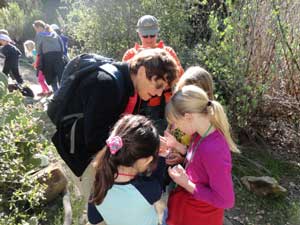
Friends of Rose Canyon President Debby Knight explores wildlife with local schoolchildren.
Friends of Rose Canyon provides guided nature walks to schools within the Rose Creek Watershed every spring.
- Project SWELL is a school-based science curriculum that teachers children about the importance of San Diego’s waterways.
- Ocean Discovery Institute provides education programs that connect underserved youth to science, inspire environmental action, and increase exposure to marine habitats.
- I Love a Clean San Diego provides environmental education programs for classrooms.
- The San Diego County Water Authority provides free educational programs and materials for grades K-12 to San Diego County educators.
- The San Diego Natural History Museum has programs for teachers that are correlated to the California Content Standards in science, history and social studies. Teacher’s Resource Guides are created for each exhibit and are also correlated to the California Content Standards. They include pre- and post-visit activities. Their Nature to You Loan Program provides free specimens for you to borrow to use as teaching tools in your classroom.
- ScienceBridge is a UC San Diego program dedicated to working with UC San Diego scientists, local schools, community groups and industry partners to innovate projects that bring the community together to promote STEM (Science, Technology, Math and Engineering) education.
- The CREEC Network lists hundreds of environmental education resources.
- San Diego Science Alliance is the trusted point of access and conduit to the best STEM (Science, Technology, Engineering and Math) resources for students, teachers and families.
- The State Education and Environment Roundtable interconnects best practices in education into an instructional tapestry that improves student achievement by using local natural and community surroundings as a context for learning.
- California Alive offers teaching products to help you explore more about California’s biodiversity and natural habitats.